
Published
- 7 min read
The Magic of Color
Terry Pratchett opened The Colour of Magic with the idea that color is never just color. It is atmosphere, meaning, and a hint that reality itself might be stranger than it looks. That turns out to be a surprisingly good place to begin a tour of the psychology of color. Because what we casually call “color” is not a simple property of the world. It is something the nervous system actively constructs, step by step, from raw physics into lived experience.
Let’s follow that construction.
Where color really begins: light, not objects
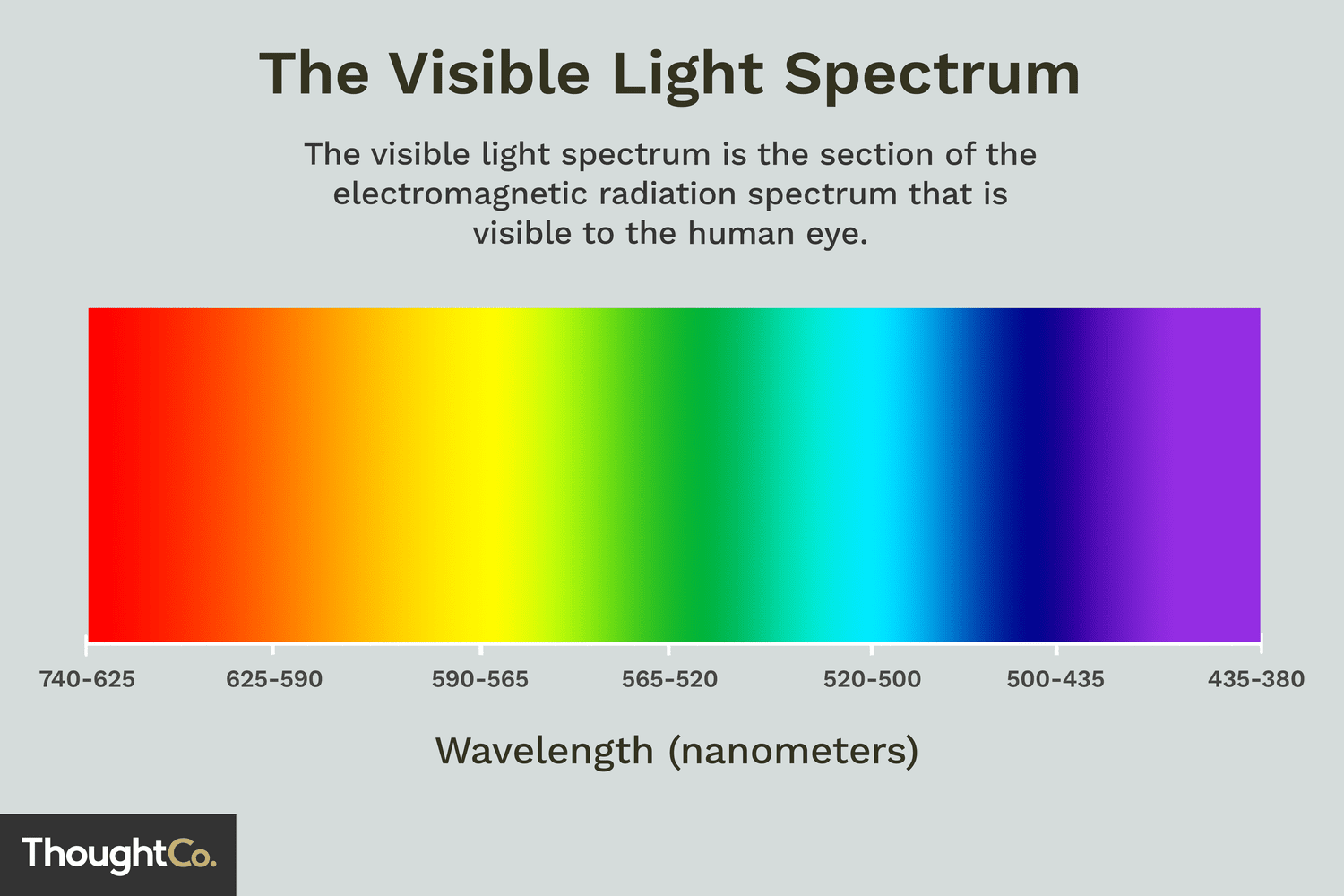
At the most basic level, color begins with light. Objects do not contain color in the way apples contain juice. Instead, they reflect some wavelengths of light and absorb others. The visible spectrum — the narrow band of electromagnetic radiation our eyes can detect — runs roughly from about 380 nanometers (violet) to about 740 nanometers (red). When sunlight hits a leaf, wavelengths in the green range are reflected more strongly, and your visual system interprets that pattern as “green”.
The visible spectrum is only a sliver of what’s out there. What is the color of a radio station’s broadcast waves? What are the colors of a Wi-Fi signal? They’re just as real as the light bouncing off a leaf — part of the same continuous electromagnetic spectrum — but our eyes and brains did not evolve the receptors or circuitry to register them. That means we don’t merely fail to see them; we can’t even reliably imagine what “colors” outside the visible band would be like.
Already, something subtle is happening. The world is continuous at this level. Wavelengths vary smoothly. There is no sharp boundary in physics where blue ends and green begins. Those boundaries arrive later.
From retina to cortex: constructing color
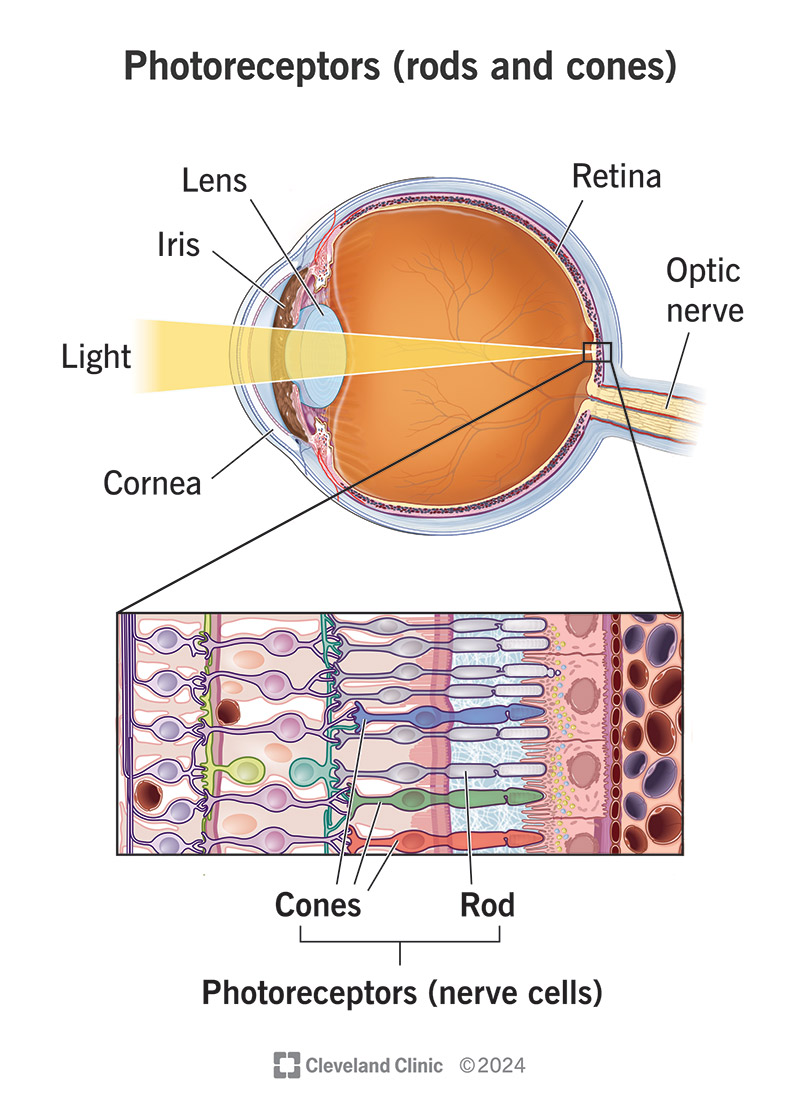
When reflected light reaches the eye, it encounters the retina, a thin sheet of neural tissue lining the back of the eyeball. Here live the photoreceptors that begin turning photons into neural signals. For color vision, the key players are the cone cells. Humans typically have three types of cones, each tuned to a different part of the spectrum: short-wavelength (S), medium-wavelength (M), and long-wavelength (L) cones.
These cones do not report “color” at all. Each one is essentially a photon counter behind a different spectral filter: over a short window of time it tallies how many photons it absorbs and sends forward a signal proportional to that count (after adaptation). Color perception begins when the visual system compares these signals rather than reading them in isolation.
That comparison is formalized by opponent processing. Circuits in the retina (and then the LGN) recast cone signals into differences and sums — roughly L-M for red-green, S-(L+M) for blue-yellow, and L+M for luminance. Opponent channels sharpen contrast and make discrimination efficient, and they help explain why combinations like “reddish green” don’t occur: the same channel cannot signal both the positive and negative sides at once.
From the LGN, these opponent-coded signals travel into the visual cortex. Early visual areas respond strongly to edges, orientation, and local contrast, while also carrying color information. But color as we consciously experience it depends heavily on higher cortical regions in the ventral visual stream, where the brain integrates these channels into stable surface colors and computes color constancy. An apple looks red at noon and red at sunset even though the spectrum reaching your eyes is very different in those two situations.
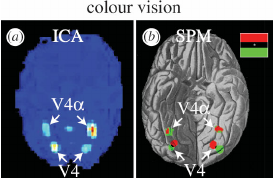
The importance of this cortical processing becomes starkly clear in cerebral achromatopsia. People with damage to ventral occipital regions (often including areas around V4) can lose color experience entirely while retaining normal vision for shape and motion. The world becomes grayscale, not because the eyes fail, but because the brain can no longer construct color as a property of objects. By this point in the cascade, color is no longer just a reaction to wavelengths — it is a feature of a perceived world, bound to surfaces, shapes, and memories.
The geometry of color experience
This is where the story becomes quietly elegant.
Cognitive scientist Peter Gardenfors proposed that many perceptual and conceptual domains are best understood as structured spaces rather than lists of features. Color is one of his clearest examples. He describes color experience as occupying a three-dimensional conceptual space defined by hue, saturation, and brightness. When visualized, this space takes the shape of a spindle or double cone.
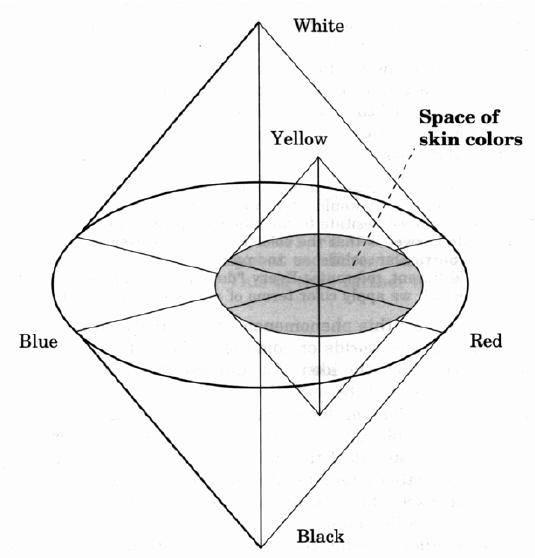
Hue runs around the circumference, like a color wheel. Brightness runs vertically, from black at the bottom to white at the top. Saturation increases as you move outward from the center. The spindle narrows near black and white because extremely dark or extremely bright stimuli carry little hue information. Vivid, highly saturated colors live around the equator.
This geometry captures something deep about how color similarity works. Colors that are close together in this space feel similar. Colors that are far apart feel different. Crucially, the space itself is continuous. There is no intrinsic place in the spindle where “blue” must stop and “green” must begin.
Categories: where language enters the picture
Yet humans do not experience color as an undivided continuum. We divide it into named regions: red, blue, green, and so on. These categories are learned, shared, and surprisingly powerful.
Psychological experiments show that color discrimination is sharper at category boundaries than within categories. If two colors fall on opposite sides of a learned boundary, people are faster and more accurate at telling them apart. This effect is especially striking in languages that draw boundaries in different places. For example, languages that distinguish light blue and dark blue with separate basic terms show enhanced discrimination across that boundary compared to languages that use a single word for both.
Memory shows similar effects. Regions of color space that are richly labeled tend to be remembered with greater precision. Where language draws finer distinctions, cognition follows.
Importantly, this does not mean that language creates color perception from nothing. The underlying sensory machinery is shared. What language appears to do is reshape the effective geometry of the color space: stretching some distances, compressing others, and sharpening certain transitions.
A quiet kind of magic
This brings us back, gently, to Pratchett.
In The Colour of Magic, the titular color is not just another hue. It is a reminder that perception and meaning are layered, constructed, and a little strange once you look closely. Modern neuroscience and psychology tell a similar story about everyday color. What feels immediate and obvious is the result of a long causal chain: photons, cones, opponent channels, cortical maps, conceptual spaces, and learned categories.
One way to frame this is what I call a geometric Whorfian hypothesis. The idea is not that language traps us in different perceptual worlds, but that it subtly reshapes the spaces in which perception and thought happen. Color is an unusually clean case because the underlying sensory space is well understood and largely shared. Against that stable backdrop, the influence of learned categories becomes visible.
Color, then, is magical in a very particular sense. Not because it defies physics, but because it reveals how mind and world meet. Reality supplies a spectrum. The brain builds a geometry. Language draws lines through it. And out of that layered construction comes the vivid, meaningful palette we live in every day.
That may not be Pratchett’s eighth color, shimmering at the edge of perception. But it is a kind of magic all the same.
Selected sources
- Gardenfors, P. Conceptual Spaces: The Geometry of Thought. MIT Press.
- American Academy of Ophthalmology, “How Humans See in Color.”
- Winawer et al. “Russian blues reveal effects of language on color discrimination.” PNAS.
- Hasantash & Afraz. “Richer color vocabulary is associated with better color memory.” PNAS.
- Zeki, S. “A vision of the brain.” Blackwell.